

FORAGE
FORensic AGE Estimation for Undocumented Young Migrants Using Advanced Artificial Intelligence
Fairer, more accurate age estimation for unaccompanied young migrants
FORAGE combines a large open dataset of CT scans, state-of-the-art artificial intelligence and low-dose imaging to improve the accuracy and reduce the uncertainty of forensic age estimation, so that minors are recognised as minors and receive the protection they are entitled to.
- 3,500+ CT studies identified of people aged 14–22
- 14–22 years: the age range no previous AI study has targeted
- 3 partner institutions: university, hospital and institute of legal medicine
- Open: anonymised dataset, code and protocols for the community
When a child is mistaken for an adult, protection fails
Unaccompanied migrant minors, and girls in particular, are among the most vulnerable people on migratory routes. European countries give them specific treatment, focused on reception, protection and care, that differs from what adults receive. But many arrive without documents, and some fall out of the protection system because they are wrongly classified as adults, leaving them exposed to violence, abuse and exploitation.
Identifying who is a minor accurately is therefore essential for treating every person ethically and fairly. Forensic age estimation is the tool used to make that decision, and its accuracy has real consequences for people’s lives.
- 36,063 people arrived in Spain by land and sea in the first eight months of 2024, 65% more than in the same period of 2023.
- 5,200 of them were unaccompanied or separated children, in the Canary Islands alone.
Source: UNHCR, Spain bi-annual fact sheet, September 2024.
How age is estimated today
Forensic age estimation follows a cascade of examinations. The final age is the highest of the minimum ages supported by each finding.
- Physical examination: anthropometric data and externally visible signs of maturity.
- Hand X-ray: size, shape and ossification status of the growth plates.
- Dental X-ray: orthopantomogram to assess mineralisation of the third molars.
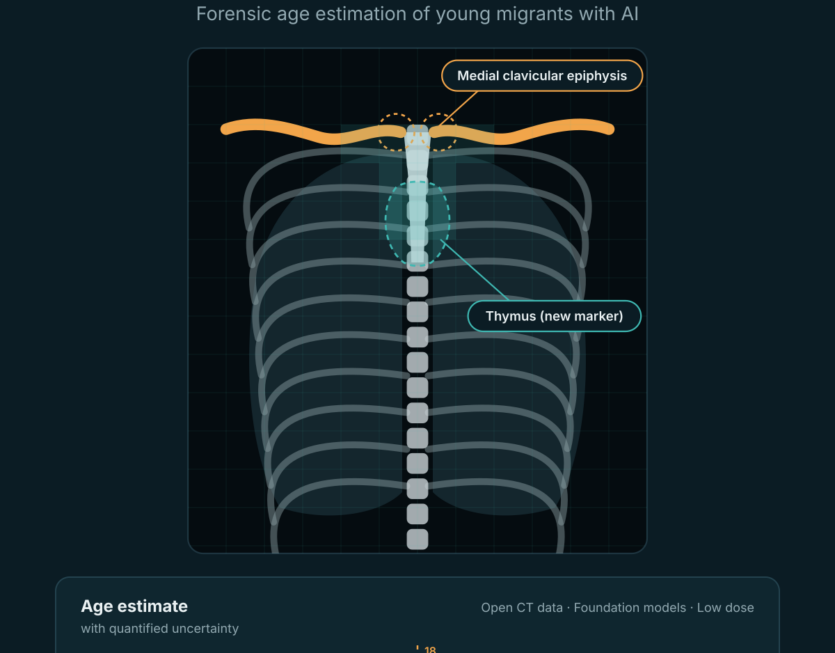
- Clavicle CT: thin-slice CT of the medial clavicular epiphysis, the last bone to ossify, graded on the Schmeling and Kellinghaus scales. This is where FORAGE works.
The gaps we address
- Visual grading is coarse and variable. Ossification stages are discrete categories that depend on the observer.
- Wrong age range. AI studies of the wrist cover 0–18 years and studies of the clavicle cover 18–26. None target 14–22, the range that matters for migrant minors.
- Closed data. Every dataset used so far is proprietary and unavailable to other researchers.
- Narrow view. Current methods look only at the clavicle, ignoring other age-related signs on the same CT scan, such as the thymus.
Open data, foundation models and lower radiation
Our main goal is to improve accuracy and reduce uncertainty in forensic age estimation of undocumented migrants using computed tomography (CT) and advanced artificial intelligence. Our hypothesis is that a large, diverse dataset and modern AI can greatly improve CT-based age estimation, and that optimised protocols can make it possible at minimal radiation dose.
- An open CT dataset. A curated, anonymised and annotated database of thoracic CT scans of people aged 14–22, with a reference standard on the Schmeling and Kellinghaus scales, published in OMOP and MIDS formats following the FAIR principles.
- Foundation models. Moving beyond convolutional networks to Vision Transformers and foundation models such as DINO, guided by anatomical knowledge from automatic segmentation tools such as TotalSegmentator.
- New age biomarkers. Exploring the whole CT image without prior assumptions, using embedding-based anomaly detection to discover and quantify age-related signs beyond the clavicle, such as degeneration of the thymus.
- Low-dose CT protocols. Acquisition protocols for the main CT vendors that keep image quality while minimising radiation, so CT-based estimation can become a front-line technique rather than a last resort.
Preliminary results
In earlier joint work on 338 subjects aged 14–22, an optimised convolutional network focused on the medial clavicular epiphysis reached a mean absolute error of 12.1 months on the test set, better than the state of the art. The error fell from 14.2 months with 50 training cases to 12.1 months with 225, which supports building a much larger dataset.
Work Plan
Four work packages over three years:
- WP1 – Management, coordination, dissemination and transfer
- Coordination of the multidisciplinary team, publication in scientific journals and conferences, outreach to society and transfer of results to the medical imaging and AI industry. Led by Germán González.
- WP2 – Creation and curation of the database
- Collection, anonymisation, standardisation and expert annotation of CT studies, and release of an open dataset split for training, validation and testing, stratified by sex, age and acquisition device. Led by José María Salinas.
- WP3 – Development and training of AI models
- Vision Transformer baselines, integration of anatomical knowledge, discovery of new biomarkers and optimisation for deployment on radiology workstations. Models are evaluated at the legal thresholds of 16, 18 and 21 years. Led by Diego Viejo.
- WP4 – Optimisation of imaging protocols
- Review of current CT protocols, design of low-dose alternatives, clinical validation on a small group of patients and standardised documentation for clinical and forensic institutions. Led by Joaquín Galant.
Ethics, privacy and gender
Privacy by design. The project has the approval of the ethics committee of Hospital Universitario San Juan de Alicante and complies with the GDPR. Images are anonymised at source and converted to a format that carries no personal data; only hospital researchers ever see raw data.
Fair for everyone. Males and females mature differently. The dataset is sex-balanced, sex is modelled explicitly, and accuracy is reported separately for each sex so that no group is disadvantaged.
Open Science
- Open dataset: anonymised CT dataset with metadata, documentation and a persistent DOI on Zenodo. [LINK – coming soon]
- Open-source code: models and tools released in a public GitHub repository. [GITHUB LINK – coming soon]
- Scientific challenge: an international challenge on the dataset, following the MICCAI Grand Challenge methodology. [DATES TO BE ANNOUNCED]
- Publications: open-access articles in journals on legal medicine, radiology and medical image analysis, and talks at conferences such as MICCAI and ISBI. [LIST OF PUBLICATIONS]
News
20260715 – Project funded by AEI
Team
FORAGE builds on more than five years of joint work between the University of Alicante and Hospital Universitario San Juan de Alicante, now joined by the Institute of Legal Medicine and Forensic Sciences of Alicante. Principal investigators: Germán González Serrano and Diego Viejo Hernando.
University of Alicante – AI and medical image analysis
- Germán González Serrano, PhD (PI)
- Diego Viejo Hernando, PhD
- Carlos Cano Espinosa, PhD
- Javier Navarrete Sánchez, PhD
- Carlos Zambrana Navajas, MSc
- Alberto López Sellers, MsC
- Gabriel Mora Rodríguez, MsC
Hospital Universitario San Juan de Alicante – Radiology and medical informatics
- José María Salinas Serrano, PhD
- Joaquín Galant Herrero, MD, PhD
- María Dolores Sánchez Valverde, MD
- Emilia Benítez Hurtado, MD
Institute of Legal Medicine and Forensic Sciences of Alicante – Forensic age estimation
- Fernando Rodes Lloret, MD, PhD
- Pedro Galiana Villa, MD
- Elisa Gavilán Turiño, MD
Contact
Researchers, forensic institutions, hospitals and companies interested in collaborating with FORAGE are welcome to contact us: [german.gonzalez@ua.es]